 404.445.7885


Some investors appeared to have sworn off equities last week. For the week, the S&P 500 Index declined 8.6%, the Dow Jones Industrial Average fell 8.0%, and the NASDAQ 100 fell 10.4%. All eleven S&P 500 sectors declined. The Consumer Staples, Utilities, and Real Estate sectors held up the best, while Technology, Communication Services, and Materials sectors saw the largest losses. The 10-year U.S. Treasury note yield ended Friday at 4.924%, down from 5.151% the previous week.
Concerns over the financing of the AI build out and further fallout from the departure of Nvidia’s CEO Jensen Huang kept pressure on equities related to AI. Comments from several Federal Reserve officials supporting further interest rate increases added additional pressure. Current CME Fed funds futures imply a 25-basis-point increase in rates at the December meeting and an additional 25-basis-point increase in January.
Third quarter earnings season is nearly complete with 93% of the companies in the S&P 500 Index having reported third-quarter results. An additional 13 companies are scheduled to report results this week. Third-quarter earnings are expected to grow 32.9% year-over-year, with revenue growth of 14.6%. For full-year 2026, earnings are expected to grow 33.7%, with revenue growth of 13.5%.
Last week’s market decline pushed the S&P 500 Index’s forward and trailing price-to-earnings ratios below their respective five- and ten-year averages. The index trades at 17.1x forward 12-month earnings, compared with a five-year average of 19.8x and a ten-year average of 19.1x. It trades at 22.9x trailing 12-month earnings, compared with a five-year average of 24.4 and a ten-year average of 23.7x.
In our Dissecting Headlines section, we look at economic data of Thanksgiving to include the cost of the turkey dinner and holiday travel plans.
Financial Market Update

Dissecting Headlines: Thanksgiving Economics
Based on data from the Farm Bureau, the cost of this year’s Thanksgiving dinner for 10 people is $58.63, 6.3% higher versus 2025, but 8.5% lower than the 2022 peak. This is the first annual increase following three years of price declines.
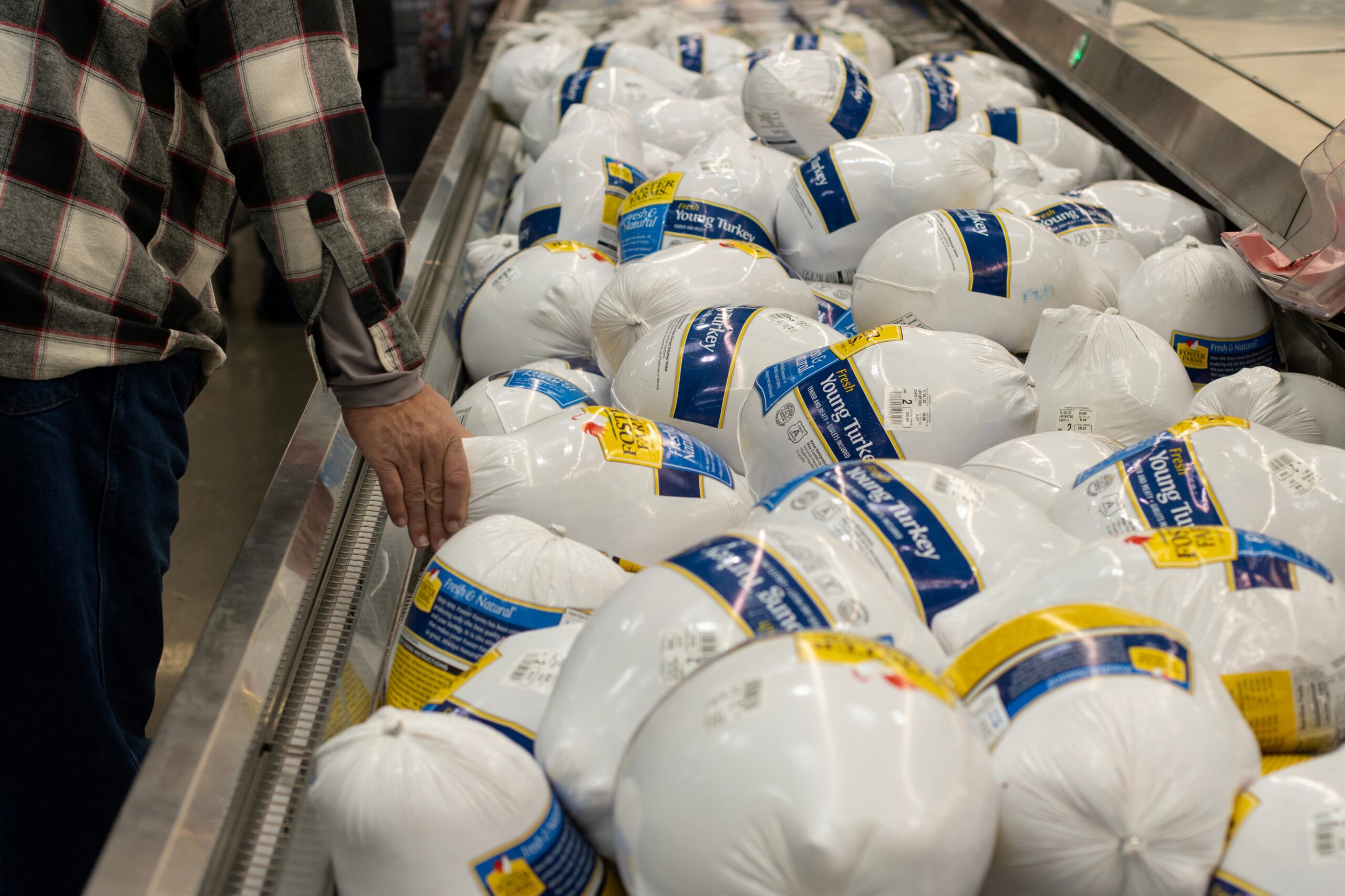
The dinner’s centerpiece, the 16-pound turkey, should cost $23.68, a 10.1% increase from last year. Several other items are seeing higher prices, including boneless ham, milk, dinner rolls, sweet potatoes, russet potatoes, frozen peas, frozen green beans, cranberries, and cubed stuffing. However, some items of the menu decreased in price, notably frozen pie crust, followed by heavy whipping cream, and a celery and carrot vegetable tray.
AAA projects 81.5 million people will travel at least 50 miles from home over the Thanksgiving holiday period from Tuesday, November 24 to Monday, November 30. This year’s domestic travel forecast is slightly lower than the 81.6 million travelers seen in 2025.
The overwhelming majority of travel will be by car with AAA projecting at least 72.9 million people, just under 90% of Thanksgiving travelers, taking to the road. Drivers are paying more at the pump with the national average for a gallon of regular gasoline at $3.64 versus $3.08 last year.
Six million U.S. travelers are expected to take domestic flights over the Thanksgiving period, flat year over year. The number of Thanksgiving air travelers over the past several years – except for 2020 – has been between 5 and 6 million. Travel by other modes is expected to increase by 4.1% to 2.6 million people. Those travelers are taking trips by bus, train, and cruise.
________________________________________
Want a printable version of this report? Click here: NovaPoint Weekly November 23, 2026
To learn more about these topics and our investment strategies, call us at 404-445-7885 or contact us here.
Do you understand your personal investment risk tolerance and the risk of your current portfolio? You can learn these by taking our Risk Analysis Questionnaire.